
About Course
Oil, Gas, and Petrochemical Operations: Become a Professional Operator
Among the professions that absorb a significant workforce in the oil, gas, petrochemical, power generation, and other large industries in Middle Eastern countries are field operators, process operators, DCS operators, rover operators, utility operators, process engineers, and other operator levels.
In this continuity professional development program, participants will learn and interact directly with practitioners and consultants who have experience as operators in the oil, gas, and petrochemical sectors.
Educator - Speaker:
Herdian Tri Juniawan - Professional Consultant, Petrochemical Operation.
Muzakkir Budiman - Professional Consultant, Oil & Gas - LNG Operation.
Introduction
With the increasing demand for energy in the world, natural gas has been the fossil energy resource with the fastest growth recently. Natural gas is a widely used clean fossil fuel which can reduce the greenhouse emissions.
Some agencies have estimated that the consumption of natural gas in the world will increase by 1.7% per year (Sieminski, 2016). As predicted by British Petroleum, the proportion of natural gas will exceed that of coal in primary energy consumption in 2035 (Dudley, 2016) (Fig. 1).
LNG is the cleanest form of natural gas due to the removal of carbon dioxide and other impurities before liquefaction (Kumar et al., 2011). The schematic of a typical onshore LNG plant (Mokhatab, 2010) is illustrated in Fig. 2. Natural gas is liquefied when it's cooled down to the temperature below −161 °C at 101.325 kPa with its volume reduced by a factor of 600. Thus, LNG has a very high energy density and is easy to transport by trucks or cargos from gas recourse to consumers (Lin et al., 2010a). However, natural gas liquefaction processes are high energy consumption process. Therefore, any performance improvement of liquefaction processes will definitely reduce the energy consumption.
There are three kinds of natural gas liquefaction processes, namely cascade liquefaction process, mixed refrigerant liquefaction process and expander based liquefaction process.
The world's first commercial LNG plant was built at Arzew, Algeria in 1964. This LNG plant applied cascade natural gas liquefaction process which was developed by Technip/Air Liquide (Bosma and Nagelvoort, 2009). The flow diagram of typical cascade natural gas liquefaction process (Andress, 1996) is presented in Fig. 3. The cascade liquefaction process comprises three independent pure refrigeration cycles as shown in Fig. 3. The three independent refrigeration cycles adopt three different boiling temperature refrigerants to provide refrigeration capacity in different temperature ranges. In cascade liquefaction process, the typical refrigerants are propane, ethylene, and methane. In propane refrigeration cycle, propane is pressurized to a high pressure by multi-stage compressor system and then cooled down using air/water cooler.
The condensed propane produces refrigeration capacity by reducing its pressure in throttling valve. Then the low-temperature propane is used to cool natural gas and other two refrigerants to approximately −30 °C. In ethylene refrigeration cycle, pre-cooled ethylene provides the cooling capacity to cool natural gas and methane to −90 °C. In methane refrigeration cycle, methane is used to liquefy the natural gas at −160 °C. The cascade liquefaction process has the highest thermal efficiency among the three kinds of liquefaction processes despite its complex process structure. In addition, the capital cost of the cascade liquefaction process is highest because of a large number of equipment involved.
Mixed refrigerant liquefaction process is designed to reduce the amount of equipment in cascade liquefaction process. The mixed refrigerant (MR) liquefaction process involves the continuous cooling of a natural gas stream by using a mixture of hydrocarbons and nitrogen (including methane, ethane, propane, i-butane, n-butane, i-pentane, n-pentane, ethylene, and nitrogen) (Mokhatab et al., 2013).
The mixed refrigerant is carefully selected to minimize the gap between the cold composite curve and hot composite curve in the multi-stream heat exchanger. As a result, the energy consumption of mixed refrigerant liquefaction process is significantly low. The most well-known mixed refrigerant liquefaction process is APCI C3MR, which is developed by Air Products and Chemicals Inc. (Liu and Newton, 1988). APCI C3MR liquefaction process has been dominant in baseload LNG plant market since it was developed.
The basic schematic of C3MR is shown in Fig. 4. C3MR liquefaction process includes two refrigeration cycles, first is three stage propane pre-cooling refrigeration cycle and the other one is mixed refrigerant refrigeration cycle (Schmidt and Kennington, 2011). The propane pre-cooling refrigeration cycle cools the natural gas and mixed refrigerant to −30 °C. Then the mixed refrigerant refrigeration cycle cools the natural gas and itself to approximately −160 °C in multi-stream heat exchangers. The existence of propane pre-cooling cycle can eliminate the big temperature difference at the warm end of the heat exchanger.
The expander based natural gas liquefaction process is a kind of reverse Brayton refrigeration cycle, as shown in Fig. 5. It usually utilizes turbo-expander to generate refrigeration to liquefy natural gas. The most common working fluids in expander based liquefaction process are nitrogen and methane. A single nitrogen expansion liquefaction process is illustrated in Fig. 6. Nitrogen is firstly pressurized by two-stage compressors and then cooled down by water coolers. Afterwards, high-pressure nitrogen enters multi-stream heat exchanger to reduce its temperature to about −60 °C or even lower and then decreases its pressure in the expander to produce refrigeration to cool the natural gas and itself. The output mechanical work by expander is used to drive the booster (He and Ju, 2015).
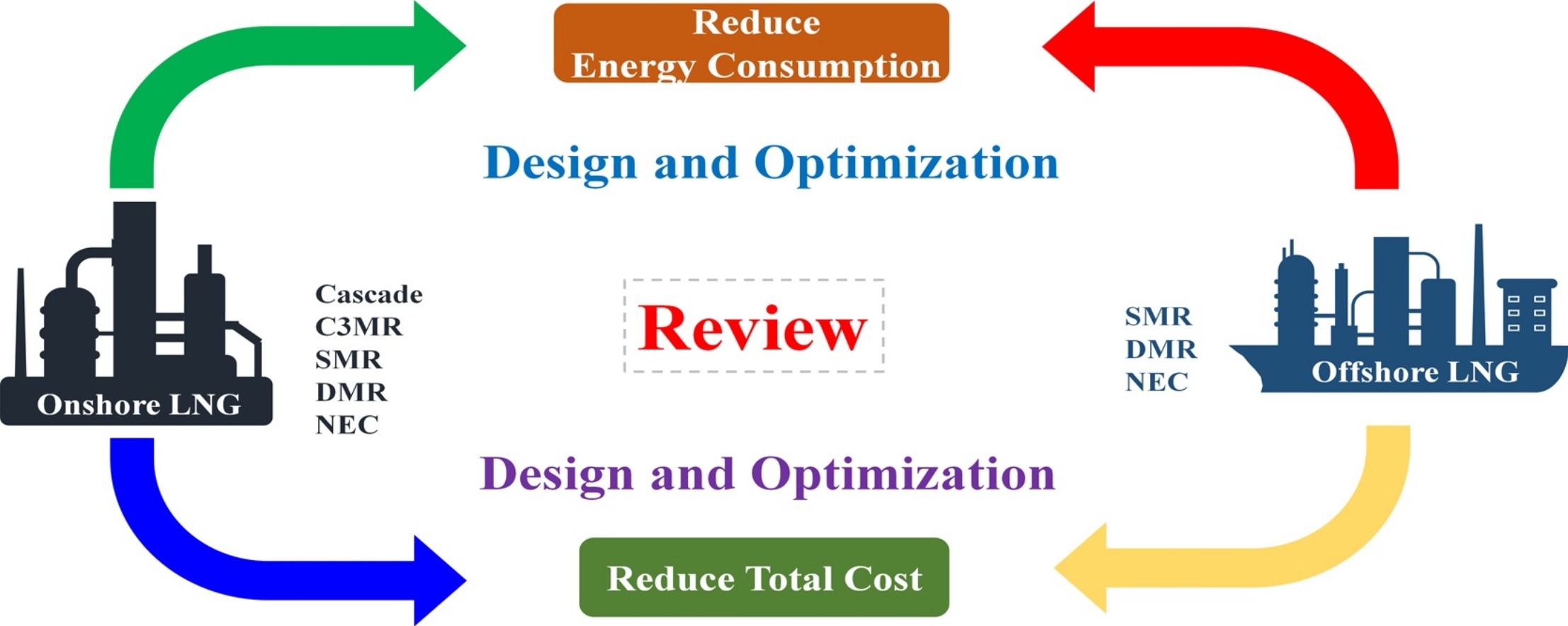
Several review papers (Khan et al., 2017, Lim et al., 2013, Chang, 2015) on natural gas liquefaction processes were published in the recent years. Khan et al. (2017) mainly focused on onshore natural gas liquefaction processes design and optimization without considering to classify the liquefaction process into onshore and offshore. The design and optimization criterions for onshore and offshore liquefaction process are different. Lim et al. (2013) reviewed the commercial natural gas liquefaction process developed by different companies. Although they mentioned offshore LNG process, the review paper was published in 2013 without including the progress on natural gas design and optimization for onshore and offshore application from 2013–2017. Chang (2015) studied the natural gas liquefaction process from the thermodynamic perspective. The author compared different cryogenic refrigeration cycles to provide some process selection criterions for engineers and researchers. This comprehensive review presents the state-of-the-art in the literature, identifying the challenges and future directions in LNG process design and optimization both for the onshore and offshore application.
The objective of this paper is to give a state-of-the-art review on recent natural gas liquefaction processes studies for onshore and offshore applications. Since natural gas liquefaction process is energy intensive, many of the researchers have focused on designing new liquefaction processes and optimizing the existing liquefaction processes. In Section 2, we will review the researches on onshore natural gas liquefaction processes, including cascade liquefaction process, mixed refrigerant liquefaction process, and expander based liquefaction process. In Section 3, we will review the studies on offshore natural gas liquefaction processes, including mixed refrigerant liquefaction process and expander based liquefaction process. Most of the researchers consider that cascade liquefaction process is not suitable for the offshore application due to its complexity process structure. In Section 4, we present the current status and remarks on recent natural gas liquefaction processes studies and give some suggestions for the future study. In Section 5, we make a conclusion and highlight the contribution of this review paper (1) Review on the design and optimization of natural gas liquefaction processes for onshore and offshore applications - ScienceDirect